Nov 14, 2026
Misty forest wall art ideas

Mist changes a forest one row at a time. The nearest pines stay dark and sharp, the ones behind turn grey, and the furthest almost disappear. That slow fade is why a misty print suits a room you want to feel quiet, and it is the mood running through much of our forest wall art. This guide is about mist alone: what it does to a picture, the wet hikes behind our own misty photographs, and how to choose, frame and pair a misty print.
Every print is made to order in 2–5 business days, printed in 12-colour giclée with pigment inks on 200 gsm matte fine art paper, and comes unframed or in a solid wood frame in an oak, walnut, white or black finish. Shipping is free worldwide.
Why mist makes a forest print calmer
A clear forest scene is full of edges: every trunk, branch and gap of sky competes for attention. Mist takes most of them away. The contrast drops, the colours narrow to a few greens and greys, and the picture sorts itself into layers, dark in front and pale behind. Your eye reads those layers as distance, so a misty print gives a flat wall some depth without adding anything busy.
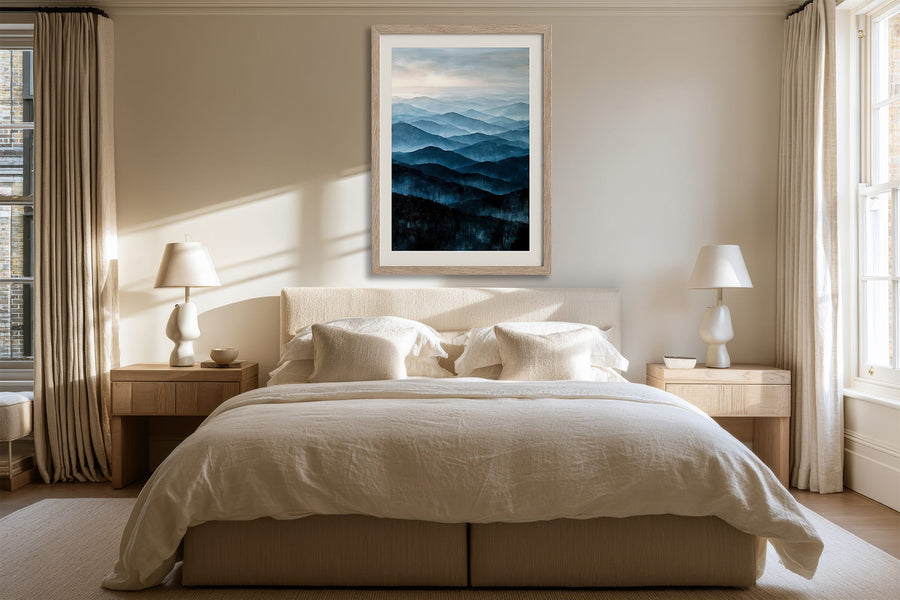
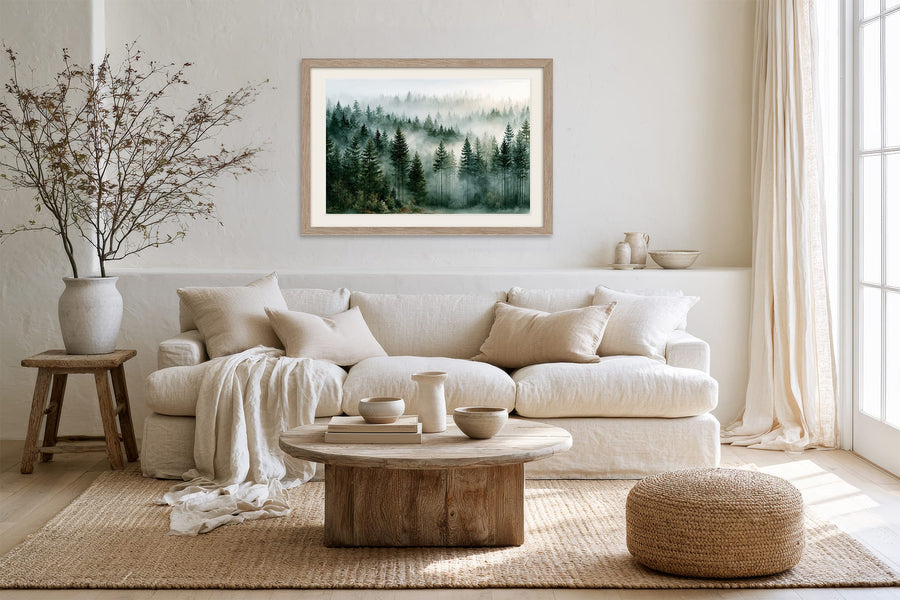
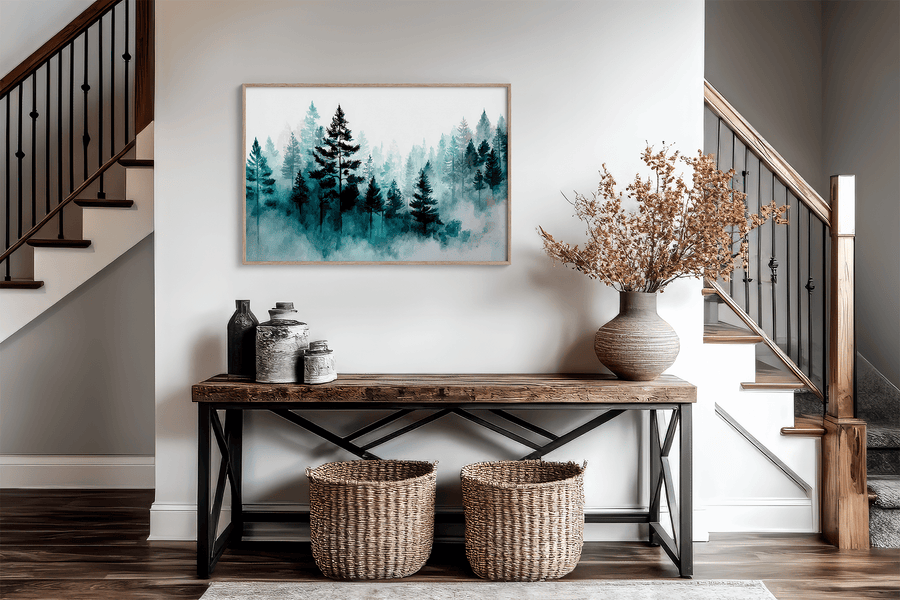
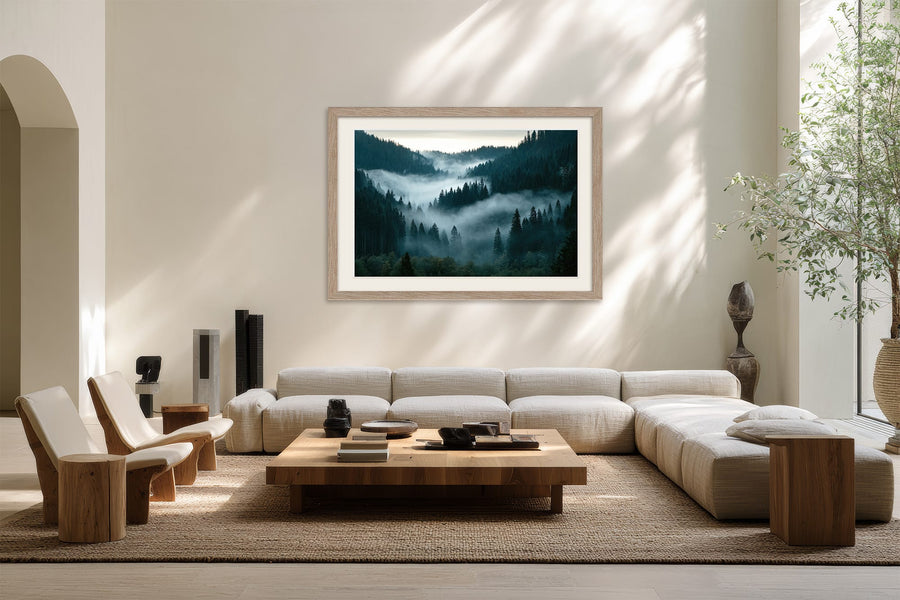
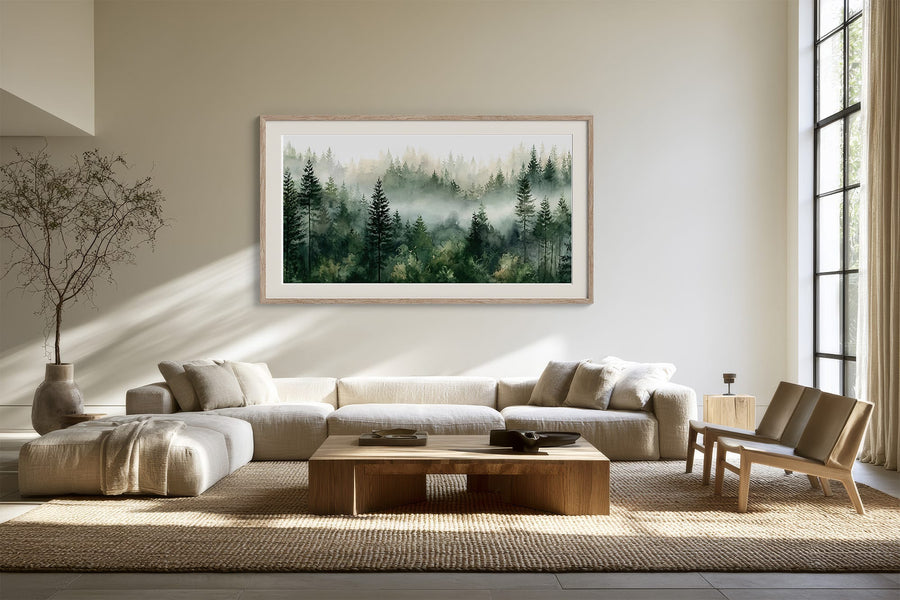
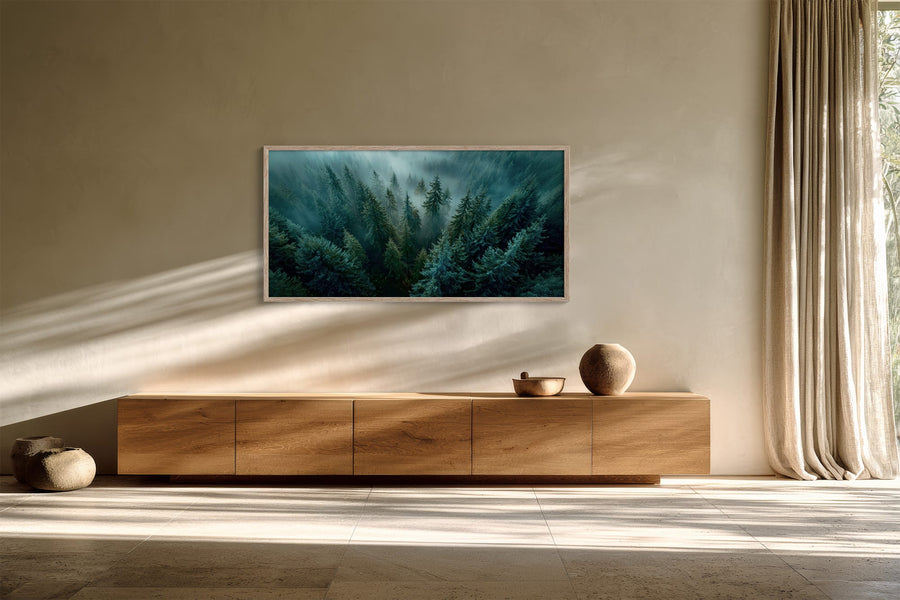
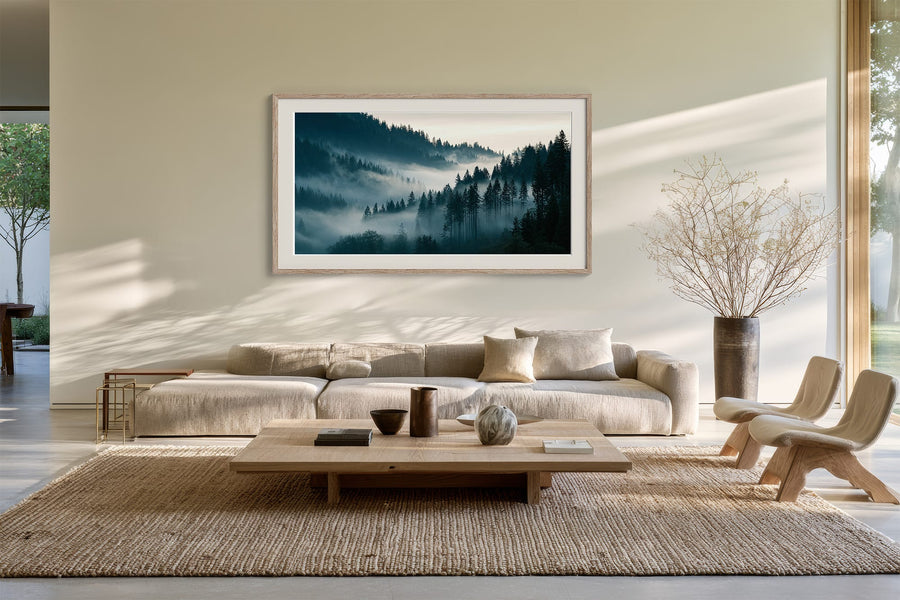
Northern Veil shows this clearly: dark spruce and fir silhouettes stand in front of paler trees that recede into blue-grey mist. In Woodland Veil the distant tree lines fade into a pale, light-washed sky, and in Veil of Pines a bank of teal mist sits at the base of the trees, so the forest seems to float. Shadowed Valley has bands of pale mist drifting between conifers across a deep valley, Greenwood Haze keeps its contrast low under a warm off-white sky, and Tall Pines looks down on a steep slope where mist gathers between the firs. If you are choosing between two, look at the top third of each: the paler it is, the lighter the print will feel on the wall.
Photographing forests in mist
Mist rarely comes with comfortable weather, and both misty forests that Barnaby, who runs Atelier Lumin, photographed himself came at a cost.
Mist Between the Pines comes from a hike in British Columbia about 15 years ago. He was shooting on a Canon 1Ds Mark III with a 16–35mm lens, and finding ground solid enough for the tripod left him very wet; he walked back with soaked feet. In the print, a gentle filter brings out the mist and the muted greens along the river. On the right bank, look for the single tall, bare trunk standing among the pines.
Frosted Pines began in Hafjell, Norway. Barnaby doesn’t ski very well, so one afternoon he went walking instead and found mist hanging between snow-covered firs. The snow was deeper than he expected: it took a while to get a shot without the tripod moving, and then a tiring two-mile hike back. A local artist painted the scene as a watercolour from his photograph, and Barnaby photographed the painting in the studio and reworked it digitally, layering the trees so each row is paler than the last. For more snow and frost through the colder months, see our winter wall art ideas.


Mist on water: lake and river scenes
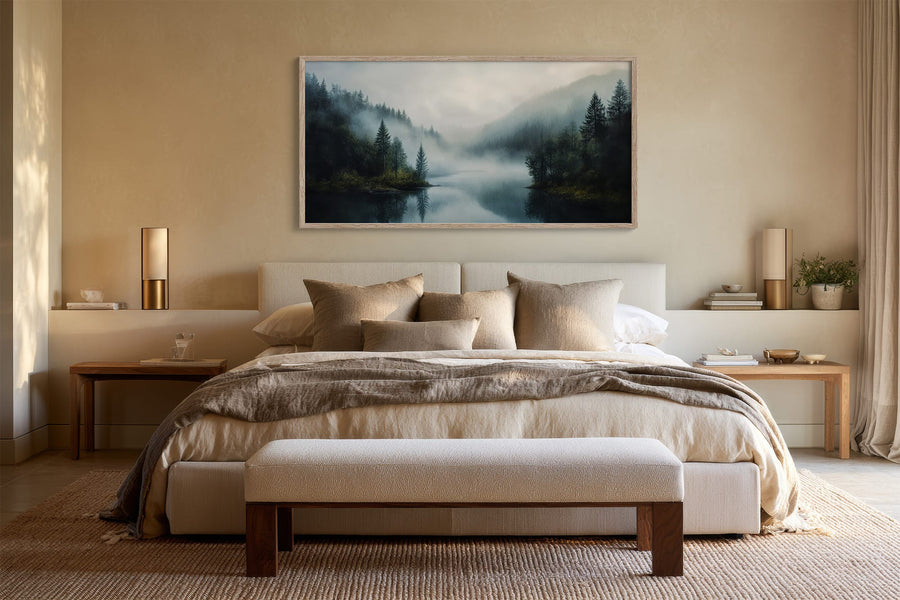
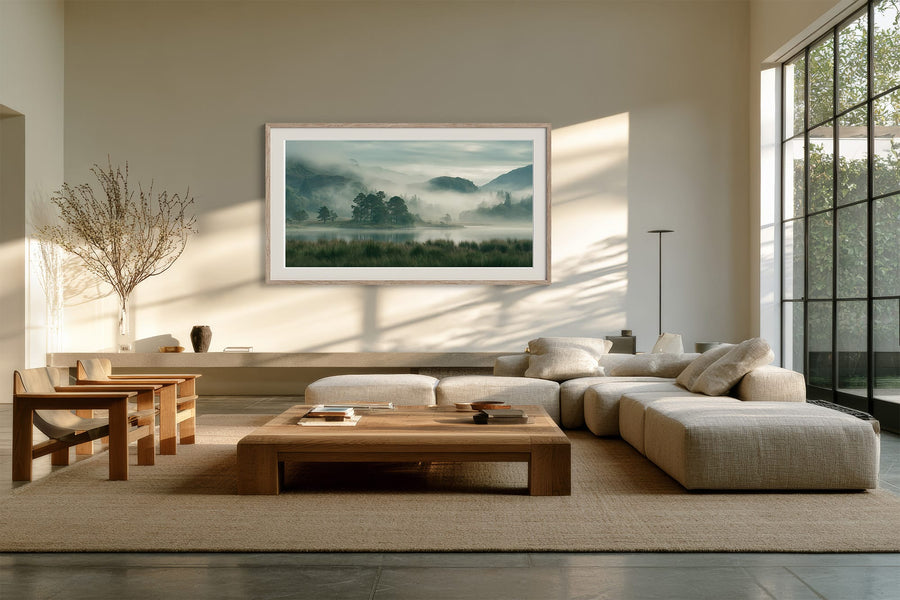
Some of the calmest misty scenes have water in them: a lake or river adds a pale band that catches the light and steadies the picture. Forest Hush frames a still lake with dark conifers, while low mist dissolves the far bank into a pale overcast sky. Morning Stillness comes in closer, with ranks of conifers above the edge of a lake and their trunks fading into low morning mist. Misted Valley puts a small shore of dark pines at the centre of a mountain lake, with mist softening the slopes behind. All three are panoramic, twice as wide as they are tall.
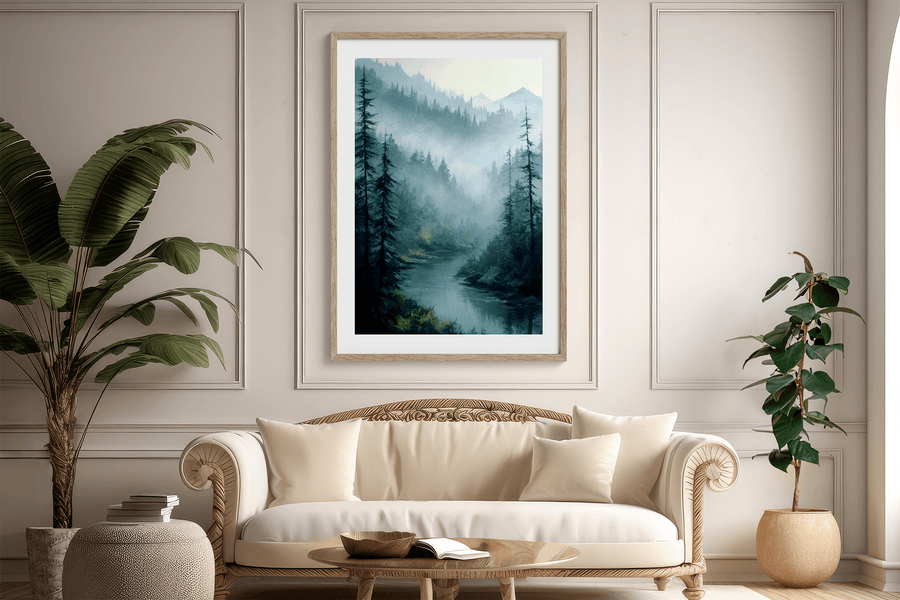
River’s Repose is the river version, and it also started with one of Barnaby’s photographs, taken in British Columbia on a cold autumn morning with mist still lying in the valley and the river barely moving. A local artist painted it as a watercolour, building the ridges in thin washes so each one sits a little paler than the last. Halfway down, look for the low rocky ledge where the river slips over a small step. See more in our rivers and lakes collection.


Mist in the hills: where forest meets mountain
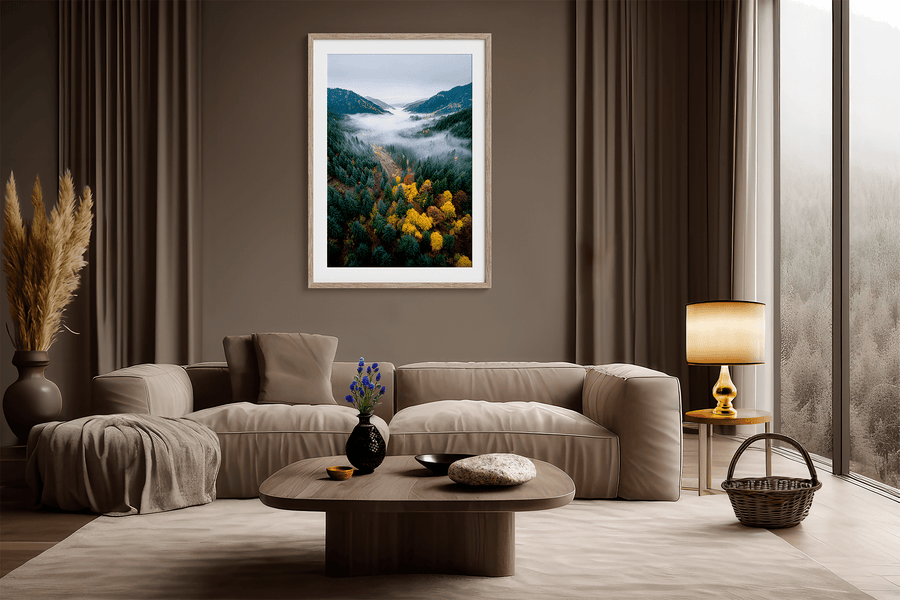
Where a forest climbs into hills, mist settles in the valleys and leaves the ridges showing, so the picture becomes a stack of dark and pale bands. Valley Drift has conifer-covered hills receding across a valley, with low white mist gathered between the trees. Mistbound Valley climbs higher, with mountain slopes fading through pale mist above a wooded valley. Autumn Above looks down on a river of fog filling a forested valley, and its bursts of yellow and red make it the warmest print in this guide. Prints like these sit halfway between our forest and mountain wall art, a good bridge if you want both in one room.
Which room suits a misty forest
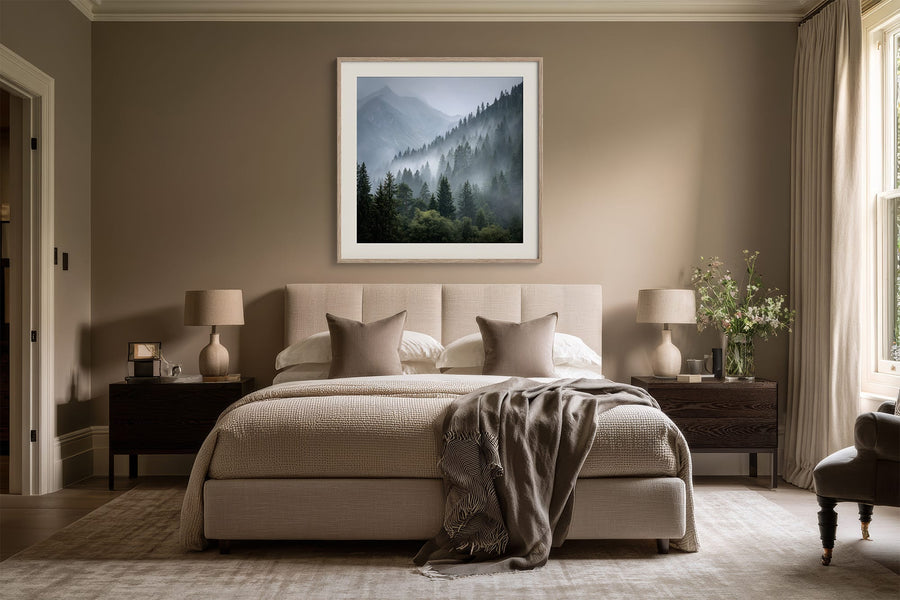
In a bedroom, choose the softest print you can find, with low contrast and plenty of pale sky. Forest Whisper is a good example: tall pines line a river that winds through a misty valley towards layered blue hills. Our calm bedroom wall art guide has more on colour and placement.
A hallway is seen in passing and from close up, so look for one strong line. In Ethereal Morning Dawn, Barnaby’s photograph from Northumberland, a narrow river runs straight into the haze between tall, dark pines. Our small hallway wall art ideas cover narrow walls.
A living room has more going on, so choose a misty print with a stronger foreground. Mistwater Valley, another of Barnaby’s photographs, is square and black and white, with bright water and fog against a dark wooded bank; Northern Veil and Shadowed Valley, with their dark foreground firs, do the same in colour.
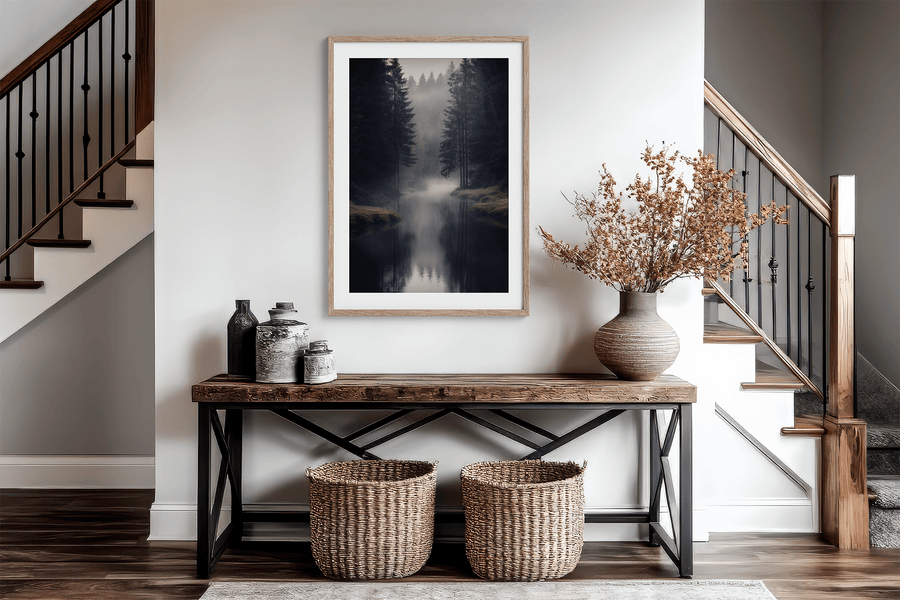

Frames for misty prints
On a misty print the frame meets the palest part of the picture, so it changes the mood more than on a darker scene. White carries that paleness out onto the wall and keeps the lightest scenes, such as Woodland Veil and Forest Hush, at their softest. Oak picks up the warm cream light in Morning Stillness and Greenwood Haze, and stops a cool green-grey picture feeling cold. Black does the opposite: it echoes the darkest foreground trees and sharpens the print, which suits Northern Veil, Veil of Pines and Mistwater Valley. Walnut, the deepest of the four, sits well with the yellow and red in Autumn Above.
A white mount suits a misty scene: the pale edges fade into white before they meet the wood.
Standard-shape prints come framed or unframed from 6" × 9" (15 × 22 cm) to 33" × 47" (84 × 119 cm). Panoramic prints such as Forest Hush are framed up to 20" × 40" (50 × 100 cm) and unframed above that. Mistwater Valley comes framed or unframed from 8" × 8" (20 × 20 cm) to 40" × 40" (101 × 101 cm). Our guide to framed and unframed prints compares the two.
Pairing misty forests with mountain prints
Haze looks much the same lying between pines as it does across a ridge, so mist is the easiest thread between forest and mountain art. Match the colour of the mist rather than the subject: blue-grey with blue-grey, green-grey with green-grey.
Stillwater Hollow has a pale river leading through conifers to a dark ridge softened by mist, so it sits easily beside the forest prints above. Mountain Echoes moves from near-black slopes to pale blue-grey peaks that dissolve into misty bands, a natural partner for Northern Veil or Shadowed Valley. Cloudbound Peak is bolder, its dark summit wrapped in low cloud above ochre grasses, for when one print in the pair should carry more weight.
Use the same frame on both, and let one print be clearly larger or darker so they don’t compete. Our mountain wall art guide covers which mountain scenes suit which rooms, and where to hang panoramic forest and mountain prints gives sizes for a long wall above a sofa or bed. For forest art beyond mist, read our forest wall art styling guide or why forest and woodland art feels so restorative.