Nov 14, 2026
Panoramic forest and mountain prints: where to hang long horizontal wall art


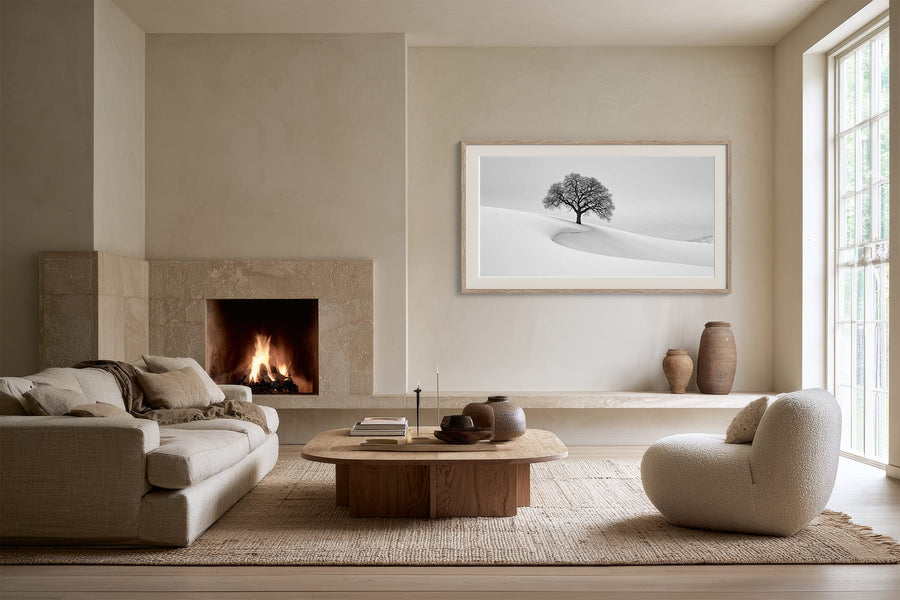
A panoramic print is twice as wide as it is tall. That makes it the natural shape for a forest edge, a mountain range or a river winding through a valley, and the easiest way to fill the long, low strip of wall above a sofa, bed or sideboard, where a standard landscape print can look a little short. Most of our panoramic wall art is misty forest, mountain river and snowy ridge, so this guide uses those prints as examples: which size to choose for your furniture, how high to hang it, and which scenes suit which rooms.
Every print is made to order within 2–5 business days, printed with 12-colour giclée inks on 200 gsm matte paper. Every size comes unframed, and sizes up to 20" × 40" (50 × 100 cm) also come in an oak, walnut, black or white frame. Shipping is free worldwide.
Why the panoramic shape suits forests and mountains
Forests and mountains are wide subjects. A treeline runs sideways, a ridge falls away to the left and right, and a river carries your eye across the view rather than up it. Squeeze that into a squarer frame and you usually lose the sense of distance that made the scene worth hanging. At 2:1 there is room for the dark trees in front, the mist in the middle and the faint slopes behind, and that layering is what gives a misty landscape its depth.
The shape also echoes the furniture below it. Sofas, beds, sideboards and benches are long and low, and a long, low print lines up with them so the wall feels settled rather than decorated. If you would rather have a standard shape, browse the full forest wall art and mountain wall art collections.
Choosing the size
The simplest rule is to make the artwork about two-thirds to three-quarters of the width of the furniture beneath it. Our guide to hanging art above furniture explains why; for panoramic prints it works out like this:
| Furniture (width) | Artwork width to aim for | Panoramic size |
|---|---|---|
| Console table or small sideboard (100 cm) | 65–75 cm | 12" × 24" (30 × 60 cm), framed or unframed; 16" × 32" (40 × 80 cm) unframed for more presence |
| Double bed (135 cm) | 90–100 cm | 20" × 40" (50 × 100 cm), framed or unframed; or 18" × 36" (45 × 90 cm) unframed |
| King-size bed (150 cm) | 100–115 cm | 20" × 40" (50 × 100 cm), framed or unframed |
| Three-seater sofa (180 cm) | 120–135 cm | 24" × 48" (61 × 122 cm), unframed |
| Large sofa (220 cm) | 145–165 cm | 30" × 60" (75 × 150 cm), unframed |
These are print sizes; a frame adds a little to each edge, so allow a few centimetres extra if you are working to a tight space. We frame panoramics up to 20" × 40" (50 × 100 cm); the larger sizes are sold unframed, ready for a framer. The two smallest sizes, 8" × 16" (20 × 40 cm) and 10" × 20" (25 × 50 cm), suit a shelf, the wall above a desk or a narrow gap between two windows.
Before you order, tape the outline of the size you are considering on the wall with masking tape and leave it for a day. It is the quickest way to see whether a print will feel generous or crowded. Our size guide has more measurements.
How high to hang a panoramic print
Above a sofa, bed or sideboard, leave 15–20 cm between the top of the furniture and the bottom of the frame. Because a panoramic print is short, it can look as if it is floating if you hang it higher, so keep that gap rather than worrying about eye level. On an open wall, aim for the centre of the print to sit about 145–155 cm from the floor.
Above a sofa
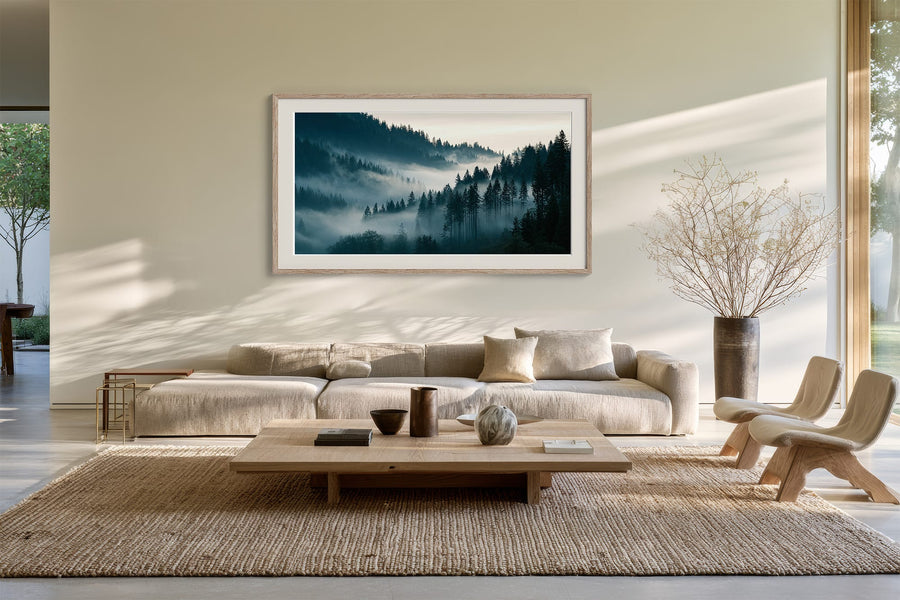
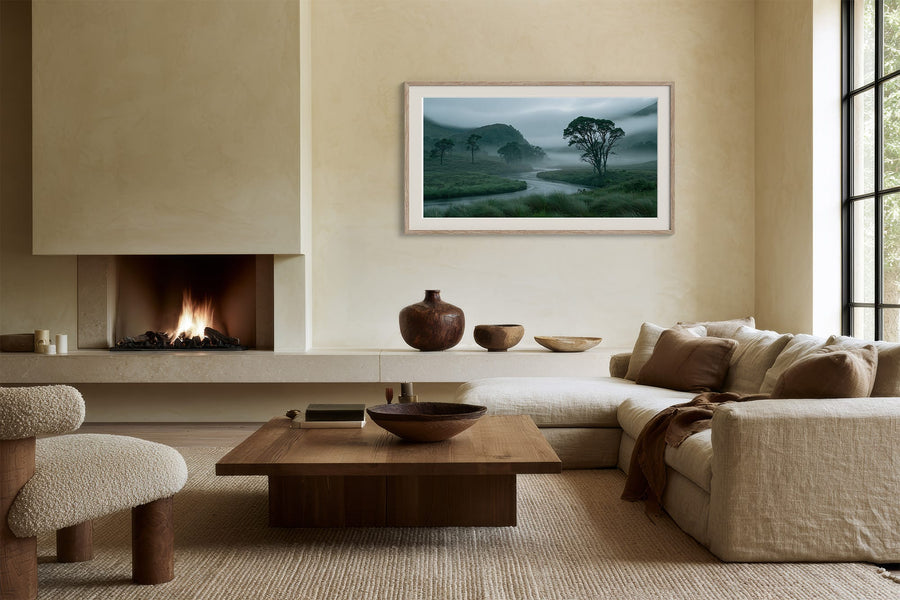
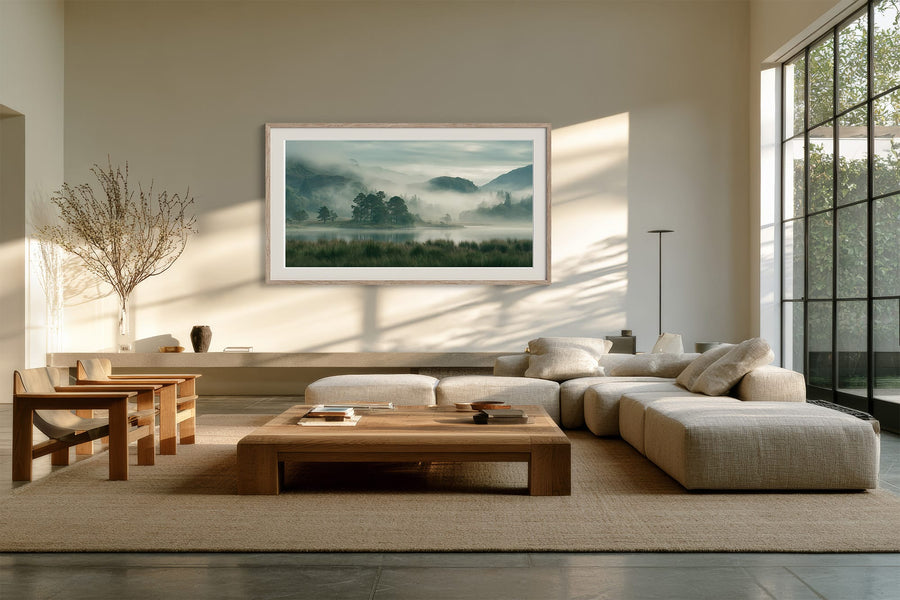
A sofa wall usually needs one calm focal point that can be seen from across the room. Look for scenes with a clear horizontal line: a lake, a valley floor or a river running across the picture. Misted Valley has a low bank of mist drifting across a still mountain lake, with dark pines gathered on a small shore. River Through the Pines follows a pale river through pine forest towards layered peaks, in a loose watercolour style. For a little more weather, Light Breaks Over the Moor has pale gold light breaking through grey cloud over a mountain valley.
Oak and walnut frames sit well with wooden floors and furniture; black gives a sharper edge in a paler room.
Above a bed
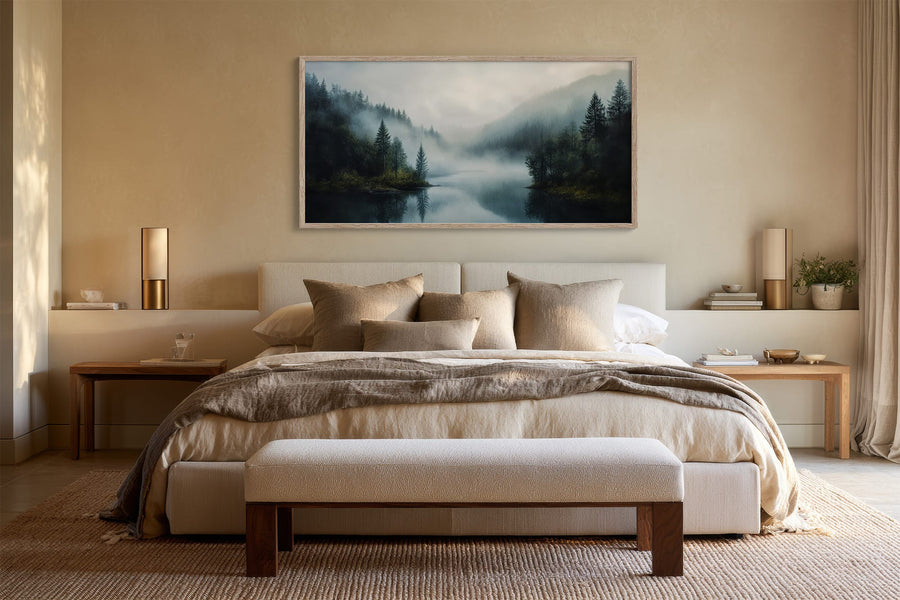
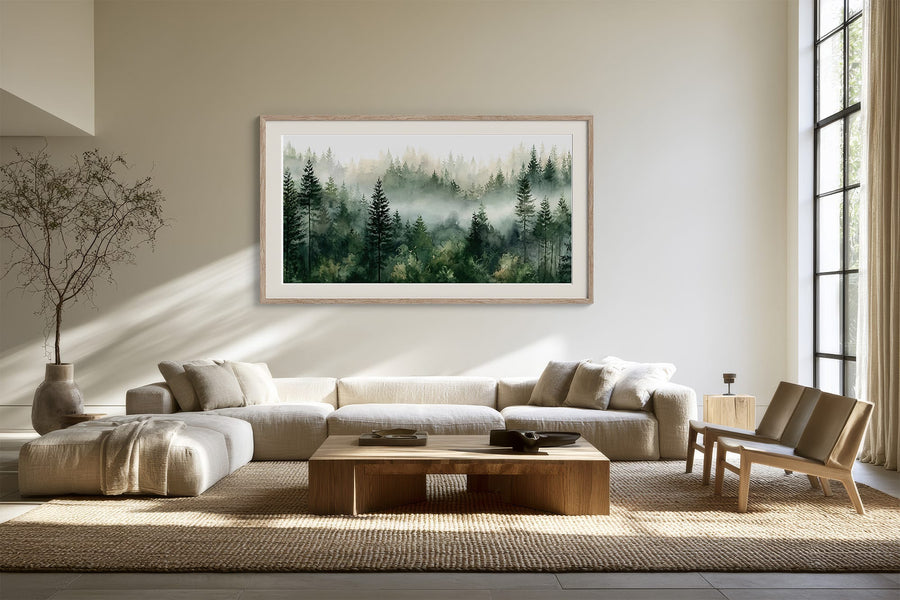
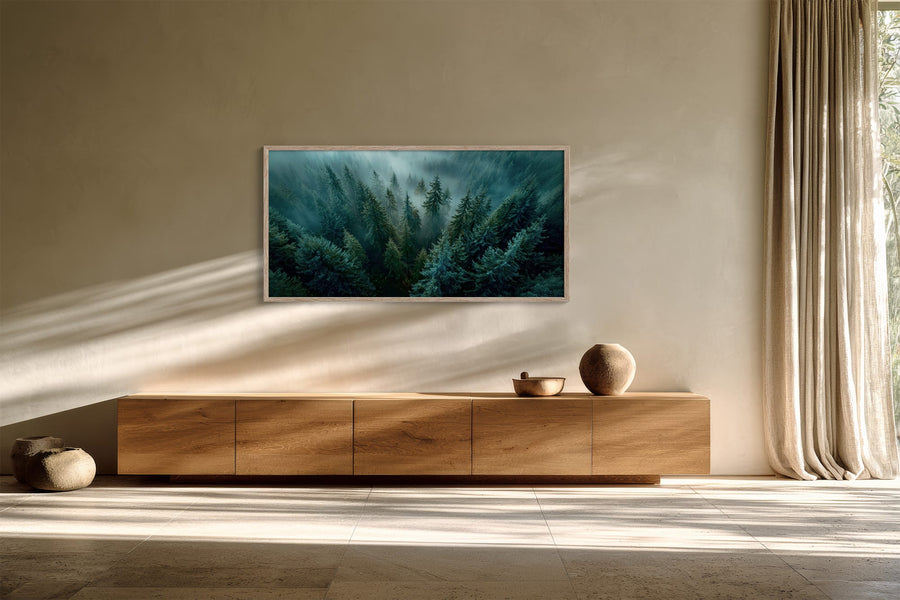
Above a bed, softer is usually better: low contrast, plenty of mist and nothing that pulls your eye when you want to rest. Morning Stillness shows dark conifers above the edge of a lake, fading into low morning mist. Greenwood Haze builds evergreen pines in washes of deep green, sage and grey against a pale sky. Tall Pines looks down on a steep slope of firs with mist gathering between them.
A white or oak frame keeps the wall light. For more bedroom ideas, see our calm bedroom wall art guide. Our misty forest wall art ideas has more soft, quiet forest scenes.

Along a hallway or landing
A long hallway wall is one of the few places where a panoramic print can hang on its own, with no furniture beneath it. Hang it at eye level so you see it as you walk past. In a narrow corridor you will be looking at it from close up, so a mid-size print such as 12" × 24" (30 × 60 cm) or 16" × 32" (40 × 80 cm) often feels more comfortable than the largest. Our small hallway guide covers narrow spaces in more detail.
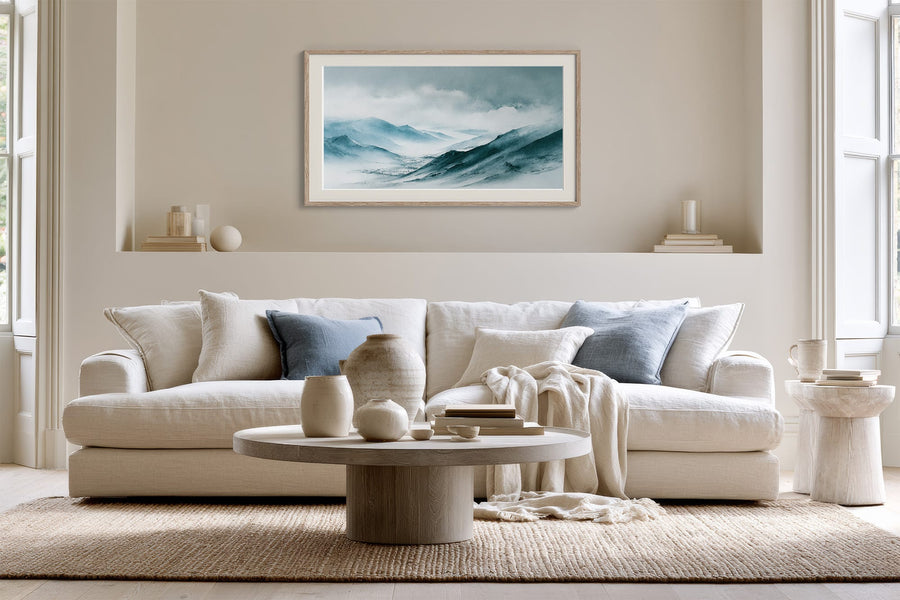
Hallways are also a good place for a winter scene through the colder months. Winter Traverse has a lone walker crossing a snowy mountain slope beneath dark ridges; Winter Stillwater has evergreens along the edge of a frozen lake; Winter Passage looks down on a snowy track through frosted firs. There are more in our winter wall art collection.


The story behind Mist Between the Pines
Barnaby, who runs Atelier Lumin, took the photograph behind Mist Between the Pines about 15 years ago while hiking in British Columbia, on a Canon 1Ds Mark III with a 16–35mm lens. He got very wet trying to find a solid spot for the tripod and walked back with soaked feet, but the view was worth it. A gentle filter brings out the mist and the muted greens. With a river winding between forested banks, it is a scene that needs the width. On the right bank, look for the single tall, bare trunk standing among the pines.

If you prefer a standard shape, River’s Repose and Frosted Pines began the same way, as Barnaby’s photographs from British Columbia and from Hafjell in Norway, before a local artist painted them as watercolours.
Frames and borders for long prints
Every panoramic print comes unframed, and the four sizes up to 20" × 40" (50 × 100 cm) also come framed in oak, walnut, black or white. Oak is the warmest and suits green forest scenes; walnut is deeper and sits well with darker furniture; black gives the clearest outline; white keeps a misty or snowy print at its lightest. For the larger sizes, or if you already have a frame, order the print unframed and check the size against the frame first.
You can also choose a white border or no border. A white border leaves a margin of paper around the image, which gives a busy forest a little breathing space. No border takes the picture right to the edge, so a wide view feels more immersive.
Panoramic print or triptych?
Both suit a wide wall. A panoramic print is one continuous image, so it tends to feel calmer: there are no gaps to break up a river or a ridge. A triptych splits a scene across three panels, which adds rhythm and suits a more structured room. Our guide to styling triptych wall art compares the two in more detail.
Find your panoramic print
Start with the furniture you want to hang above, pick the size from the table, then choose the scene: a lake or valley for a sofa wall, soft misty forest for a bedroom, snow for a hallway in winter. For ideas beyond the panoramic shape, read our mountain wall art guide and forest wall art styling guide, or browse the full panoramic collection.